A glance at history of boxes, tombstone of Imam Reza (AS)
The history of the development of Imam Reza Shrine was examined from installation of the first wooden and metal boxes to the artistic features of the current tombstone in an interview with Reza Naqdi, head of Imam Reza Research Institute at Islamic Research Foundation of Astan Qods Razavi (AQR).
The holy shrine of Imam Reza (AS) has historically been a focal point for artists and devotees who have shown their devotion to this complex by crafting exquisite boxes and unique tombstones. Dr. Reza Naqdi, who has studied the history and organization of the holy shrine for many years, is a person served as director of the major project "Encyclopedia of Endowments". The Excerpts of Interview:
Please briefly explain history of tombstone of Imam Reza (AS).
Based on historical sources, boxes and chambers have been placed over the grave of Imam Reza (AS) throughout history. However, it seems that until the first Pahlavi era, the grave of Imam Reza (AS) did not have a tombstone, only a box and a chamber were there.
Why didn't Imam's grave have a stone?
Firstly, Imam Reza (AS) was so renowned that there was no need to place a marker stone on his grave. Secondly, for most great figures before the Timurid era, only a structure or a box existed over their graves. It was from the Safavid era onward that installation of a chamber and replacement of the holy box over the crypt of Imam Reza (AS) took place.
You mentioned the crypt. How long has that crypt existed?
The earliest account of this dates back to the 4th century AH. In the book Uyun Akhbar al-Ridha, Sheikh Saduq mentions that at the time of the Imam's (AS) burial, they excavated seven steps down into the grave.
Which period does the first box placed over the Imam's grave belong to?
It is not known for certain whether a box or chamber existed over the grave from the time of Imam Reza's (AS) burial until the mid-4th century AH. Given the flourishing of pilgrimage and settlement of Shia people around the area; however, it seems there were boxes over the grave until the Timurid period. Consequently, in the 4th century AH, a competition arose concerning the installation of a box.
Could you explain about famous historical boxes, like the Anoushirvan box and the Shah Abbasi box?
A box covered in silver was installed by Anoushirvan the Zoroastrian in the 6th century AH. He had made a vow to do so after being cured of vitiligo at the shrine. This box remained until the Safavid period. Then, in 1022 AH, Shah Abbas I replaced it with a new box made of areca wood decorated with carved gold sheets. This box was dismantled in 1932 due to decay, and its gold inscriptions are now kept in the museum of the holy shrine.
How did the tombstone and subsequent boxes change?
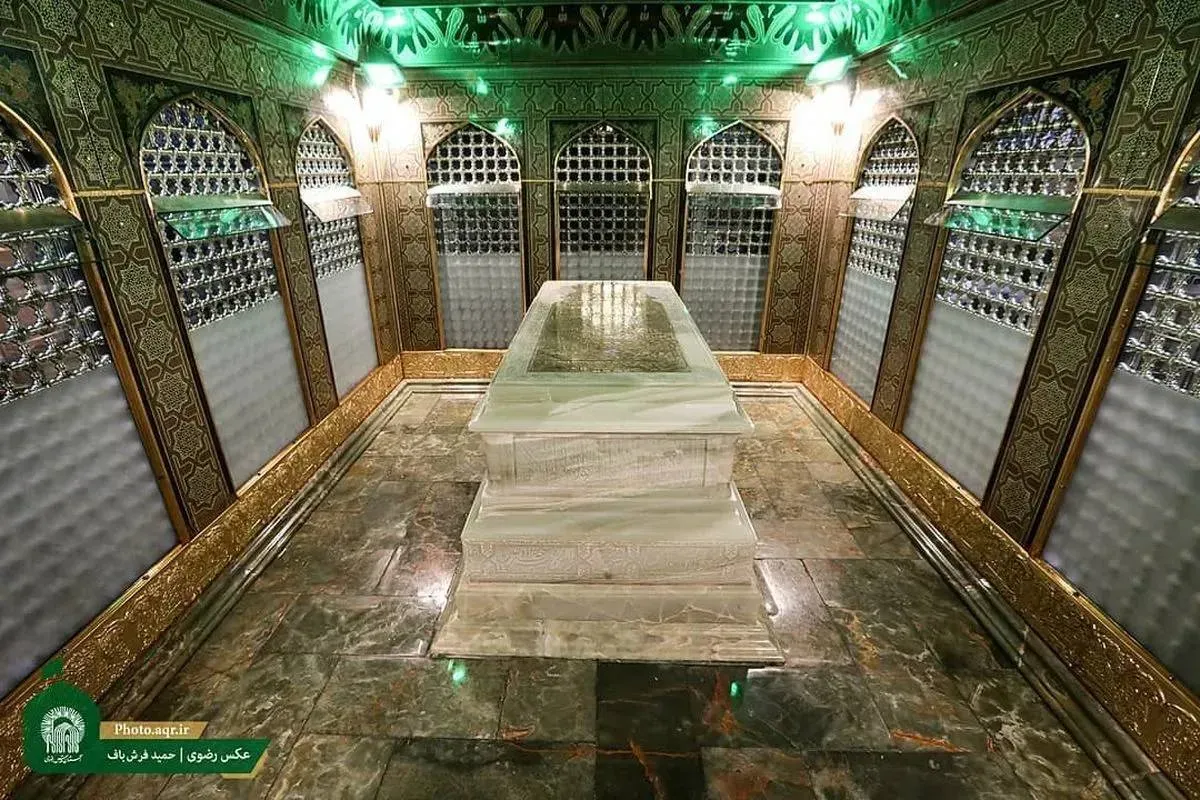
After the dismantling of Shah Abbasi box, a box made of lemon-colored marble from Shandiz was installed over Imam's (AS) crypt in January 1933. This was prepared by Hossein Hojjarbashi Zanjani. This box consisted of 14 pieces and was so delicately made that light could pass through it. Finally, a tombstone made of green marble which holds special sanctity for Iranians replaced the previous one during the chamber replacement in 2000-2001. Much searching was done to obtain it, and eventually, a 35-ton block of stone was sourced from the Turan Posht mine in Yazd. The design was carried out by engineer Reza Deyshidi.
What are artistic details and inscriptions on the current stone?
The carving of this stone took two years by Babak Masoudi Zanjani, with engraving done according to traditional principles. The Sols script was done by Seyyed Mohammad Hosseini Movahed; the Persian poetry in Nasta'liq script was calligraphed by Mohammad-Ali Shariati Sarabi. The raised lettering was cut from copper and then mounted on the stone after being plated by gold. The stone, with a final weight of 3600 kg, was installed on 14th Dhu al-Qi'dah 1421 AH in presence of Iran's martyred Leader Ayatollah Seyyed Ali Khamenei.
Dr. Naqdi has published many articles and books on shrine studies. He has also written introduction to the holy boxes and chambers of Imam Reza Shrine for AQR Encyclopedia and has a detailed book on the subject awaiting publication.
Related News

Post comments
- Editor's suggestion
- Latest news
Islamic Revolution’s message transcends national borders
6th Imam Reza International Congress concludes
Intl. scholars explore Razavi justice, resistance against structures of domination
Researchers explore the Ahl al-Bayt’s (AS) distinctive perspectives on justice
Imam Reza Congress, vital platform for strengthening unity of Islamic Ummah
African thinker highlights inseparable link between Razavi teachings, governance model of Martyred Leader
Martyred Leader’s martyrdom resonates across religious boundaries in Latin America
Imam Reza Shrine remains a focal point of convergence for nations, religions
Human rights defined through Imam Reza’s teachings, human dignity: Scholar
Imam Reza’s teachings, “jihad of clarification” ensure invincibility of Resistance: Yemeni researcher
US researcher links Imam Reza’s foresight, Martyred Leader’s legacy to governance
International scholars examine human dignity and rights in light of Imam Reza’s teachings
Scholars examine formation of an independent and self-reliant resistance front against hegemonic powers
6th Imam Reza International Congress explores human rights, Razavi teachings
RUIS professor explains various dimensions of Abdul Azim Hassani’s lifestyle and teachings
Razavi shrine library, a treasury of Persian poets works
Imam Reza’s legal perspectives have gained global prominence
Global power redefined through Razavi teachings and reflected in a leadership model
IRIU, Ministry of Foreign Affairs forge scientific diplomacy ties
Future diplomats tour Imam Reza Shrine
Iraqi students visit Imam Reza Shrine
Campaigns