6th Imam Reza International Congress concludes
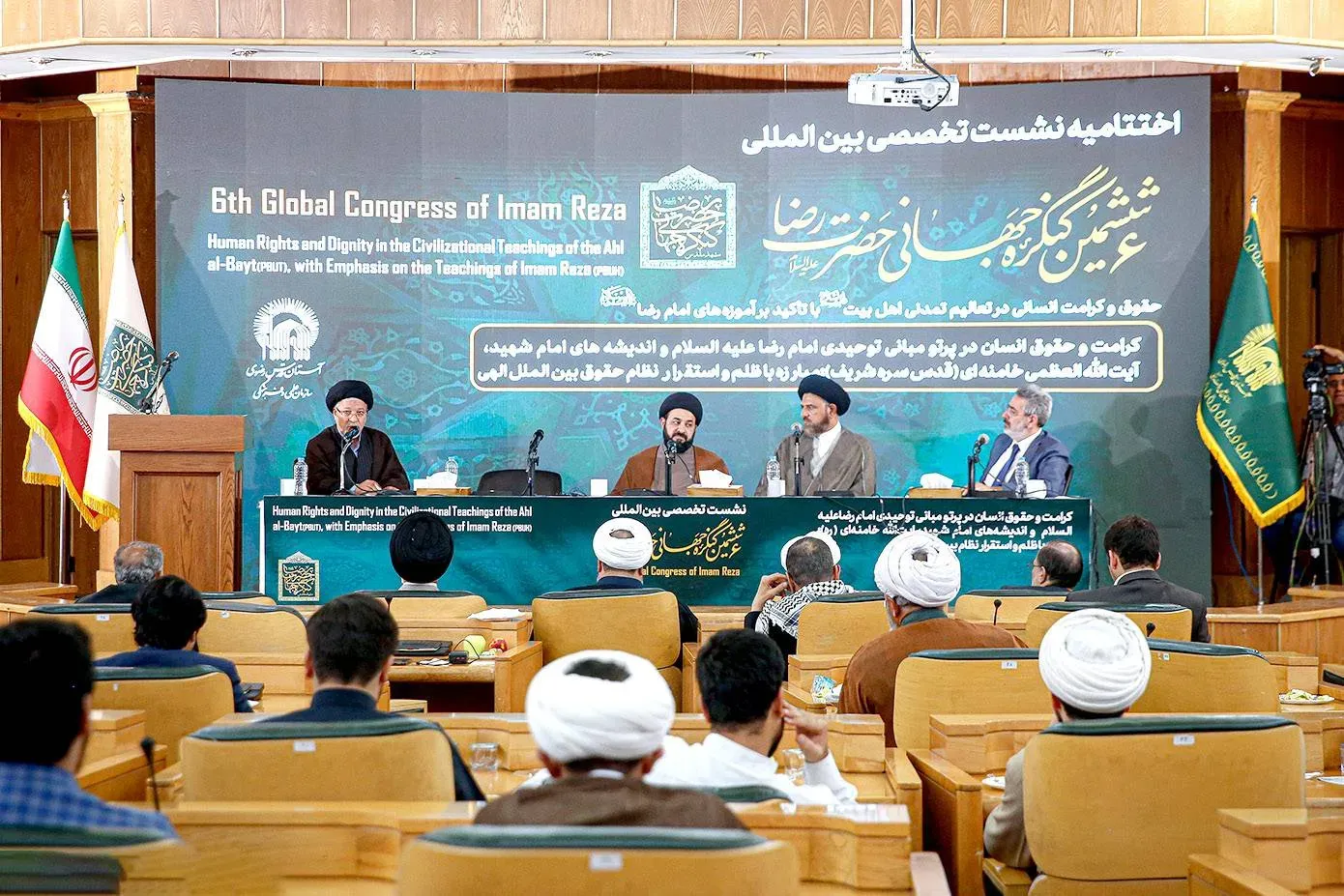
The closing ceremony of the 6th Imam Reza International Congress was held with an emphasis on the link between Razavi teachings, justice, human dignity, resistance against hegemony, and the need to move toward a new Islamic civilization.
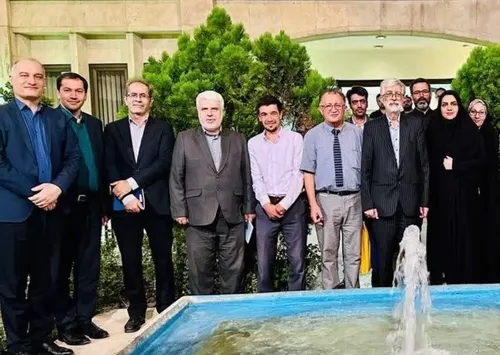
The closing ceremony was attended by thinkers and experts from various countries. According to the congress secretary, the event served as a pre-session for next year’s main congress. Discussions at the closing ceremony focused on the capacity of Imam Reza’s (AS) teachings to address the challenges facing contemporary society.
At the ceremony, Saeed Reza Ameli, dean of the Faculty of World Studies at the University of Tehran and secretary of the Global Congress of Imam Reza; Hoj. Seyyed Morteza al-Sanadi, leader of Bahrain’s Tayyar al-Wafa al-Islami movement; and Rony Alfa from Lebanon presented their views on resistance, power, interfaith dialogue, and the requirements for the formation of Islamic civilization.
In his remarks, Saeed Reza Ameli said, “Today’s program is the international meeting of the Global Congress of Imam Reza and a pre-session for the main congress that will be held next year.”
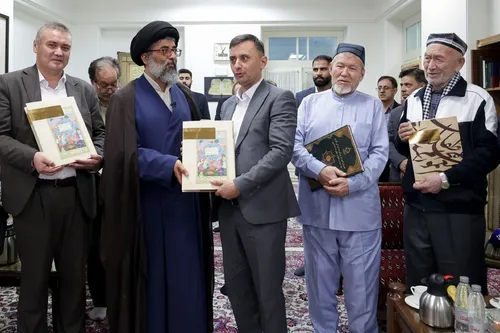
Referring to the publication of new works on Razavi teachings, Ameli added, “The effort is to make greater use of languages in which the thoughts and teachings of Imam Reza (AS) have been less widely published.”
Ameli identified the “right to confront systems of hegemony” as a common theme in the discussions of the six sessions held as part of the program, saying, “This right does not belong only to Muslims; all freedom-seeking people around the world have such a right in the face of oppression.”
Referring to messages from the martyred Leader of the Islamic Revolution, Ayatollah Seyyed Ali Khamenei, addressed to young people in the West, he added, “The invitation to stand on the right side of history is ultimately linked to a fundamental principle: rejecting oppression and refusing to side with the oppressor.”
The secretary of the Global Congress of Imam Reza identified “power” as another common theme of the sessions, particularly the interfaith panel, saying, “The martyred Leader’s emphasis on a ‘strong Iran’ was aimed at achieving the power needed to confront oppression. Such power is not limited to the military sphere; science, economic capacity, civilizational values, and a strong nation are also its components.”
Referring to support for Palestine and the resistance movement, Ameli said, “A clear gap has emerged in recent years between the positions of nations and those of some governments. People in many parts of the world have taken action in support of truth and the people of Palestine, while a number of governments have pursued a different path.”
He stated, “The martyred Leader of the Islamic Revolution played a major role in strengthening the self-confidence of the resistance movement, which led to the expansion of this movement in Lebanon, Yemen, Palestine, Iraq, as well as popular movements in countries such as the United States, Canada, and Australia.”
Referring to the continued presence of the Iranian people in support of resistance, he added, “This steadfastness prevents fatigue and retreat from overcoming the resistance movement.”
Ameli continued, “Before confronting external powers, the martyred Leader of the Islamic Revolution waged a constant struggle against the self, and this internal foundation was a prelude to confronting oppression in the social and political spheres.”
He described the United States, in the intellectual framework of the martyred Leader of the Islamic Revolution, as an example of an arrogant system and, referring to his own remarks about the existence of 780 US military bases around the world, said, “The martyred Leader’s opposition to the United States and Israel is understandable as a continuation of the struggle against hegemony, corruption, and oppression and an effort to establish justice.”
Ameli also referred to the Statement of the Second Step, describing the “New Islamic Civilization” as the horizon of this path, and said, “The issue facing humanity today is civilizational in nature, and the response to it must also be sought on a civilizational scale.”
Referring to the status of Jesus (AS) in the era of reappearance, he added, “Divine truth is one, and this very truth can provide a basis for followers of different religions to draw closer to one another.”
In the continuation of the closing ceremony, Hoj. Seyyed Morteza al-Sanadi, leader of Bahrain’s Tayyar al-Wafa al-Islami movement, cited verses from the Holy Quran and described power in Islamic thought as distinct from material and hegemonic power.
Al-Sanadi said, “The path of the Islamic Revolution was built on the power of faith, and this path continued during the era of the martyred Leader of the Islamic Revolution, Ayatollah Seyyed Ali Khamenei.”
Referring to the martyrdom of Ayatollah Seyyed Ali Khamenei, he added, “Martyrs are alive, and from this perspective, the influence of the martyred Leader is not limited to physical or temporal presence. His thought and path can continue across geographical boundaries.”
He considered serious attention to scientific progress one of the characteristics of this approach and, referring to the martyred Leader’s dedication to young people and universities, said, “Scientific progress, knowledge production, and the presence of young people in the fields of innovation are essential components of the power of an Islamic society.”
Al-Sanadi further noted, “Building Islamic civilization cannot be reduced to possessing missile and military power; civilization requires comprehensive power in the scientific, economic, political, cultural, and social spheres.”
In another part of the closing ceremony, Rony Alfa from Lebanon remembered the martyred Leader of the Islamic Revolution, Ayatollah Seyyed Ali Khamenei, as a philosophical and cultural figure.
Identifying himself as a Christian, he said, “Getting to know and meeting the martyred Leader was an experience that reduced my sense of alienation and made me feel closer to Islamic culture, the Imam (AS), and God.”
Emphasizing the necessity of interfaith dialogue, the Lebanese thinker added, “Walls should not be built between Christianity and Islam. Followers of both religions must have the courage to open windows toward one another so that, through this dialogue, they can better understand the truth of God.”
Alfa also spoke about his experience of becoming acquainted with Imam Reza (AS), saying, “After becoming acquainted with Imam Reza (AS), I made a vow to myself to write about him. After the pilgrimage, an inner pull led me to a greater understanding of Imam Kazim (AS).”
Referring to the lack of works about Imam Kazim (AS) for Christian audiences, he said, “This issue motivated me to write a work about that Imam in a language accessible to Christian audiences. I also found commonalities between the teachings of the Ahl al-Bayt (AS) and certain themes found in the Christian tradition.”
He added, “This path continued with the writing of works about the Twelve Imams (AS) and Sahifa Sajjadiya. I am now thinking of beginning my fourth work.”
It is worth noting that the 6th Imam Reza International Congress concluded its work by summarizing discussions on justice, human dignity, interfaith dialogue, resistance against oppression, and the need for the Islamic Ummah to possess scientific, economic, cultural, and social power. These topics form the scientific basis for the pre-sessions of next year’s main congress.
Related News
Post comments
- Editor's suggestion
- Latest news
Islamic Revolution’s message transcends national borders
6th Imam Reza International Congress concludes
Intl. scholars explore Razavi justice, resistance against structures of domination
Researchers explore the Ahl al-Bayt’s (AS) distinctive perspectives on justice
Imam Reza Congress, vital platform for strengthening unity of Islamic Ummah
African thinker highlights inseparable link between Razavi teachings, governance model of Martyred Leader
Martyred Leader’s martyrdom resonates across religious boundaries in Latin America
Imam Reza Shrine remains a focal point of convergence for nations, religions
Human rights defined through Imam Reza’s teachings, human dignity: Scholar
Imam Reza’s teachings, “jihad of clarification” ensure invincibility of Resistance: Yemeni researcher
US researcher links Imam Reza’s foresight, Martyred Leader’s legacy to governance
International scholars examine human dignity and rights in light of Imam Reza’s teachings
Scholars examine formation of an independent and self-reliant resistance front against hegemonic powers
6th Imam Reza International Congress explores human rights, Razavi teachings
RUIS professor explains various dimensions of Abdul Azim Hassani’s lifestyle and teachings
Razavi shrine library, a treasury of Persian poets works
Imam Reza’s legal perspectives have gained global prominence
Global power redefined through Razavi teachings and reflected in a leadership model
IRIU, Ministry of Foreign Affairs forge scientific diplomacy ties
Future diplomats tour Imam Reza Shrine
Iraqi students visit Imam Reza Shrine
Campaigns