Global power redefined through Razavi teachings and reflected in a leadership model
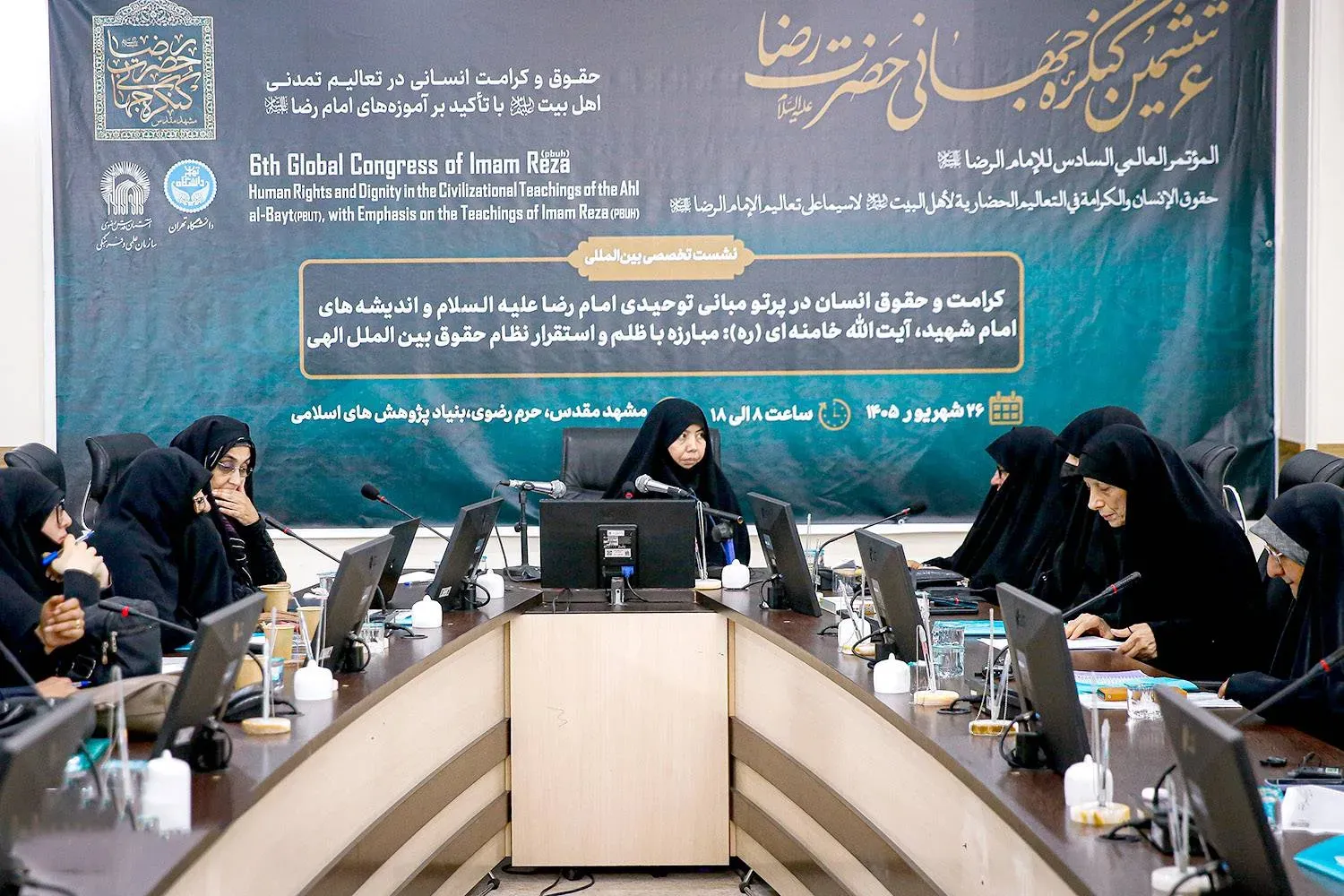
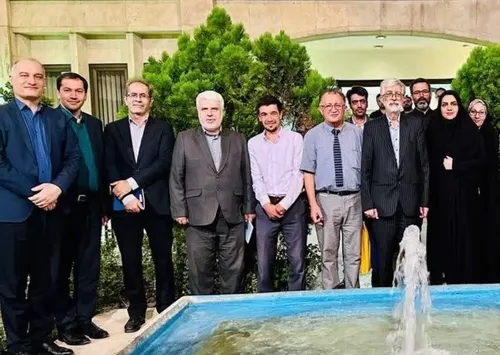
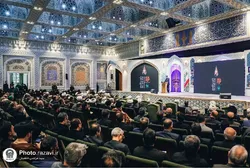
International scholars gathered at the 6th Imam Reza International Congress to examine the role of Islamic civilization and the Martyred Leader’s approach to global leadership.
The session explored the concept of a “new Islamic civilization” and Iran’s potential as a fourth global power.
Participants focused on applying the principles of Imam Reza—justice, human dignity, and resilience—to contemporary governance.
Speaking at the event, Dr. Roghayeh Fazel argued that evaluating Iran using conventional metrics such as military hardware misses the point.
“In a new global order, true power derives from civilization-building grounded in monotheism and justice,” she stated.
She highlighted how Imam Reza navigated the political pressures of the Abbasid era, demonstrating that authentic Islamic currents can flourish even under hostile conditions.
Salwa Al-Nimr, a scholar from the Hejaz, examined the Martyred Leader’s profound spiritual connection to the Imam Reza Shrine.
She explained: “The Martyred Leader’s upbringing in Mashhad shaped his leadership style, which emphasized universal human values.”
“Like Imam Reza, whose forced relocation to Khorasan became a platform for global intellectual discourse, the Martyred Leader engaged with diverse thinkers, showing that the Islamic message transcends geography and ethnicity,” she added.
Zeynab Seyyedeh Mirza, a Canadian educator, spoke on the transformative nature of martyrdom.
She noted: “A martyr’s message endures, challenging people to move beyond passive observation. True ‘witnessing’—the root of martyrdom—requires individuals to testify to the truth through personal action and character. Pilgrimage to the Imam Reza Shrine provides a site for this spiritual witnessing, linking visitors to the path of the Imam.”
Elsewhere, Arezou Merali, from the Islamic Human Rights Commission in London, highlighted the inclusive nature of the Martyred Leader’s leadership. Referring to his respect for Christian martyrs, she illustrated the point: “His governance transcended religious boundaries. This model of justice threatened hegemonic systems because it prioritized empowering ordinary people and mobilizing social resistance against oppression, rather than seeking political dominance.”
Also speaking, Hana Al-Mousawi emphasized that the protection of the Muslim Ummah begins with the protection of consciousness.
She argued: “True unity does not require erasing sectarian differences, but rather preventing those differences from weakening collective strength against external exploitation.”
She defined the resistance front as an organized effort to achieve independence and preserve identity.
Ghada Al-Hosseini from France noted that Iran’s global standing is bolstered by its independence from hegemonic systems and reliance on domestic capabilities. She argued that power is legitimate only when it serves human dignity.
Homa Eftekar Hassan, an American preacher, concluded the session by praising the “fatherly” leadership of the Martyred Leader.
She pointed to his consistent encouragement of hope and resilience, asserting: “The patience of the Ahl al-Bayt should serve as the fundamental model for modern society.”
Related News

Post comments
- Editor's suggestion
- Latest news
RUIS professor explains various dimensions of Abdul Azim Hassani’s lifestyle and teachings
Razavi shrine library, a treasury of Persian poets works
Imam Reza’s legal perspectives have gained global prominence
Global power redefined through Razavi teachings and reflected in a leadership model
IRIU, Ministry of Foreign Affairs forge scientific diplomacy ties
Future diplomats tour Imam Reza Shrine
Iraqi students visit Imam Reza Shrine
Razavi University, al-Mustafa International University launch joint cooperation center
Malek Museum unveils exhibition on devotion to Prophet Muhammad
Khorasan Razavi MPs support AQR development plans for Imam Reza Shrine
AQR research deputies strengthen international synergy
Darvazeh Bathhouse reflects Safavid-era history in Mashhad: Expert
Sunni influencer recalls shattered stereotypes during visit to Imam Reza Shrine
International Islamic Unity Conference continues strategic vision of Iran’s leaders
Iran is a unique model of peaceful coexistence: Muslim activist
Imam Reza Shrine plays pivotal role in Islamic unity: Bahraini scholar
40th Islamic Unity Conference concludes in Mashhad
40th Islamic Unity Conference concludes in Mashhad
Imam Reza Shrine adorned for birth anniv. of Prophet, Imam Sadiq
Arab pilgrims honor birth anniv. of Prophet, Imam Sadiq
Afghan collector donates rare stamps to AQR
Campaigns